
Corporate office:- 320, Ahimamau Arjunganj , Lucknow Uttar Pradesh - 226002.
Branch Office :- Shanti Nagar Colony , Near Padmawati Mahila Degree College Chitaipur BLW , Varanasi - 221106.
An on-grid, or grid-tied, solar system converts sunlight into electricity using photovoltaic (PV) cells, similar to standalone systems. The key distinction is its direct connection to the public utility grid. Instead of relying on batteries for storage, on-grid systems seamlessly feed any excess electricity generated back into the grid, often earning credits or payments through net-metering policies.
Cost and Maintenance Considerations in India:
Generally, the initial investment for an on-grid solar system in India is lower compared to an off-grid setup. This is primarily because it eliminates the need for expensive battery banks, which are a significant component in standalone systems. Furthermore, on-grid systems typically incur fewer maintenance costs and effort, as there are no batteries to periodically replace, simplifying system operation and ensuring a longer, more trouble-free lifespan.
To provide a general cost estimate, here are approximate market prices for on-grid solar systems in India:
3 kW On-Grid Solar System
5 kW On-Grid Solar System
Please Note: These figures are standard market estimates and do not represent pricing from TAKSHAYA POWER PRIVATE LIMITED, as our primary focus is on providing tailored on-grid solar solutions. Actual costs may vary based on specific components, installation complexity, and available government subsidies.
Beyond the major components, a range of essential solar accessories ensures the safe, efficient, and reliable operation of the entire on-grid system. These include:
Cabling (DC and AC): Specifically rated and sized cables are crucial to minimize energy loss and ensure the safe transmission of electricity throughout the system, from panels to inverter and to the grid.
Combiner Boxes: Used to aggregate wiring from multiple solar panel strings, these boxes often house overcurrent protection (fuses or circuit breakers) for each string, enhancing system safety and fault isolation.
Disconnect Switches: Critical safety devices that allow for manual isolation of different parts of the system (both DC and AC sides) for maintenance, troubleshooting, or emergencies, as well as for utility grid requirements.
Grounding Equipment: Essential for electrical safety, grounding protects the system and occupants against electrical faults and potential lightning strikes, meeting stringent safety standards.
Surge Protectors: These devices safeguard sensitive electronic equipment within the solar system and the home from voltage spikes caused by lightning or other electrical disturbances from the grid or environment.
Monitoring Systems: Increasingly common, these systems allow users to track real-time system performance, energy production, and consumption. Often accessible via mobile apps or web portals, they provide valuable insights into energy savings and operational status.
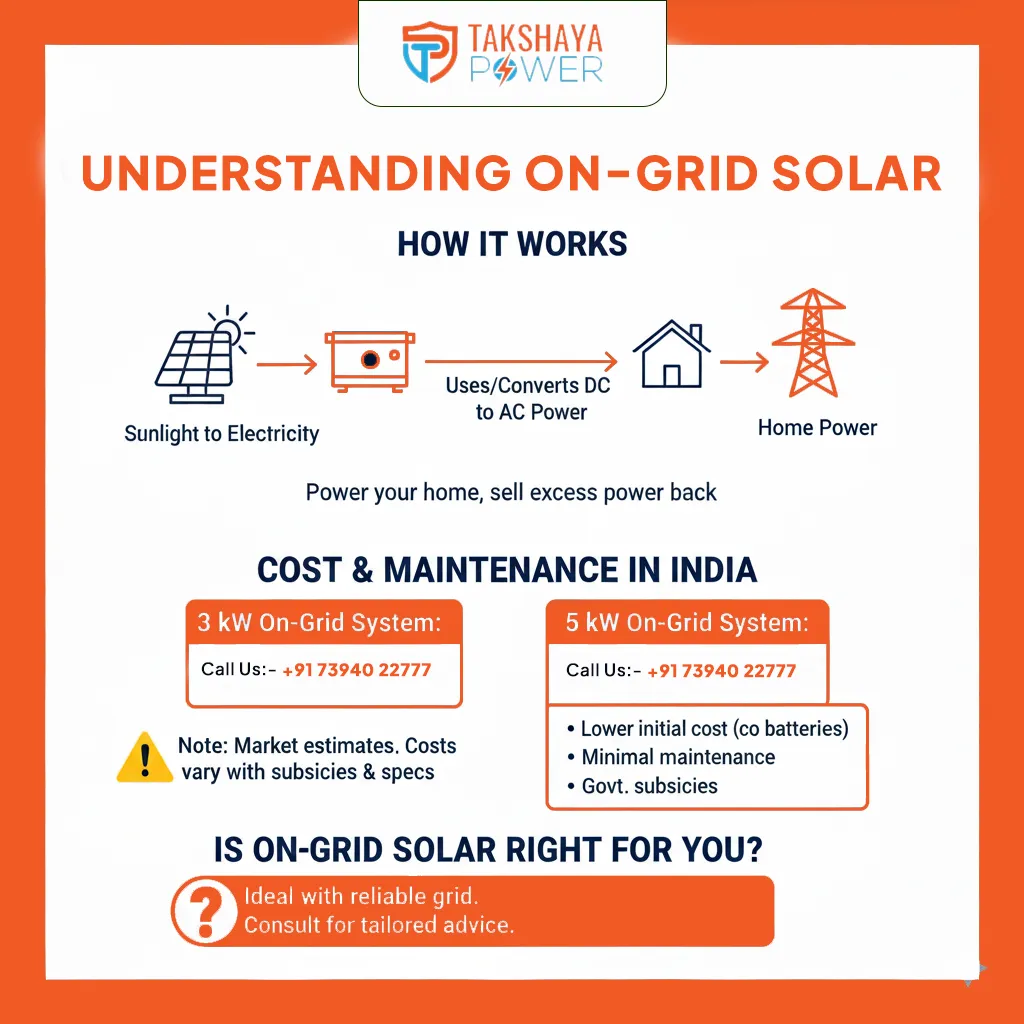
For the vast majority of Indian homes, on-grid rooftop solar systems represent the most practical and advantageous solution. They are typically more affordable to install and require less maintenance than alternative solar setups, efficiently meeting household power demands.
An on-grid solution is the ideal choice when:
Your location has a reliable and stable public utility grid connection.
You wish to reduce your electricity bills significantly and leverage government subsidies for solar installations.
You want to contribute to environmental sustainability without the complexities of battery storage.
In essence, for homeowners connected to a robust and consistent grid, an on-grid solar system offers unparalleled benefits in terms of cost-effectiveness, ease of use, and environmental impact
Now, let’s break down the entire on-grid solar system component by component so you can understand the role of each individual part in generating and integrating electricity with the public utility grid.
Solar panels are composed of solar cells and are the primary units for converting sunlight into electricity.
When made from a single silicon crystal, the resulting panel is monocrystalline, known for higher efficiency and sleek appearance.
When made from multiple silicon crystals, the resulting panel is polycrystalline (multicrystalline), offering a more cost-effective option.
When designed to capture sunlight from both the front and rear, the resulting panel is bifacial, maximizing energy capture.
On-grid solar panels trap sunlight and convert it into Direct Current (DC) electricity. For optimal performance, it is crucial during installation to ensure that panels are not shaded, allowing for maximum sunlight absorption.
The power generated by solar panels is in the form of Direct Current (DC), while most home appliances and the utility grid operate on Alternating Current (AC). This is where the solar inverter plays its crucial role: it converts the DC power into AC power. An on-grid solar inverter is essentially the “brain” or “heart” of the solar system, responsible not only for conversion but also for synchronizing the generated power with the grid’s frequency and voltage.
Unlike off-grid systems, on-grid solar systems do not typically use batteries for primary energy storage. Instead, they are directly connected to the public utility grid.
During sunshine hours, the electricity generated by the panels first powers the house’s needs.
Any surplus electricity is automatically fed back into the utility grid.
When solar production is insufficient (e.g., at night or on cloudy days), the house draws electricity directly from the grid, ensuring a continuous power supply.
This exchange is managed by a process called net metering, where excess power fed to the grid can earn credits or reduce electricity bills.
In an on-grid solar system, a dedicated charge controller, as found in off-grid systems, is generally not required. Its function of managing power flow to batteries is irrelevant because there are no batteries for primary storage. The solar inverter directly handles the power from the panels and manages its export to the grid or consumption by the home.
Proper mounting structures are indispensable for an on-grid solar system. These structures securely hold the solar panels in place, typically on rooftops or ground arrays. The mounting structures must be installed at an optimal tilt angle and orientation to the sun to ensure the panels receive maximum sunlight exposure throughout the day, thus maximizing electricity generation for home consumption and grid export.
While the main components form the core, various other accessories are vital for the safety, efficiency, and compliance of an on-grid solar system. These essential accessories include:
DC cables and DC combiner box: For aggregating DC power from panels before the inverter.
AC cables and AC combiner box: For safely transmitting AC power from the inverter to the home’s electrical panel and the grid.
MC4 connectors: Standardized connectors for secure and weather-resistant DC wiring.
Earthing strips and conduit trays: Crucial for electrical safety, protecting against faults and ensuring proper grounding.
Lightning arrester: A device to protect the system and the property from damage due to lightning strikes.
Net Meter: A special bi-directional meter installed by the utility company to track both electricity drawn from the grid and excess electricity fed into it.
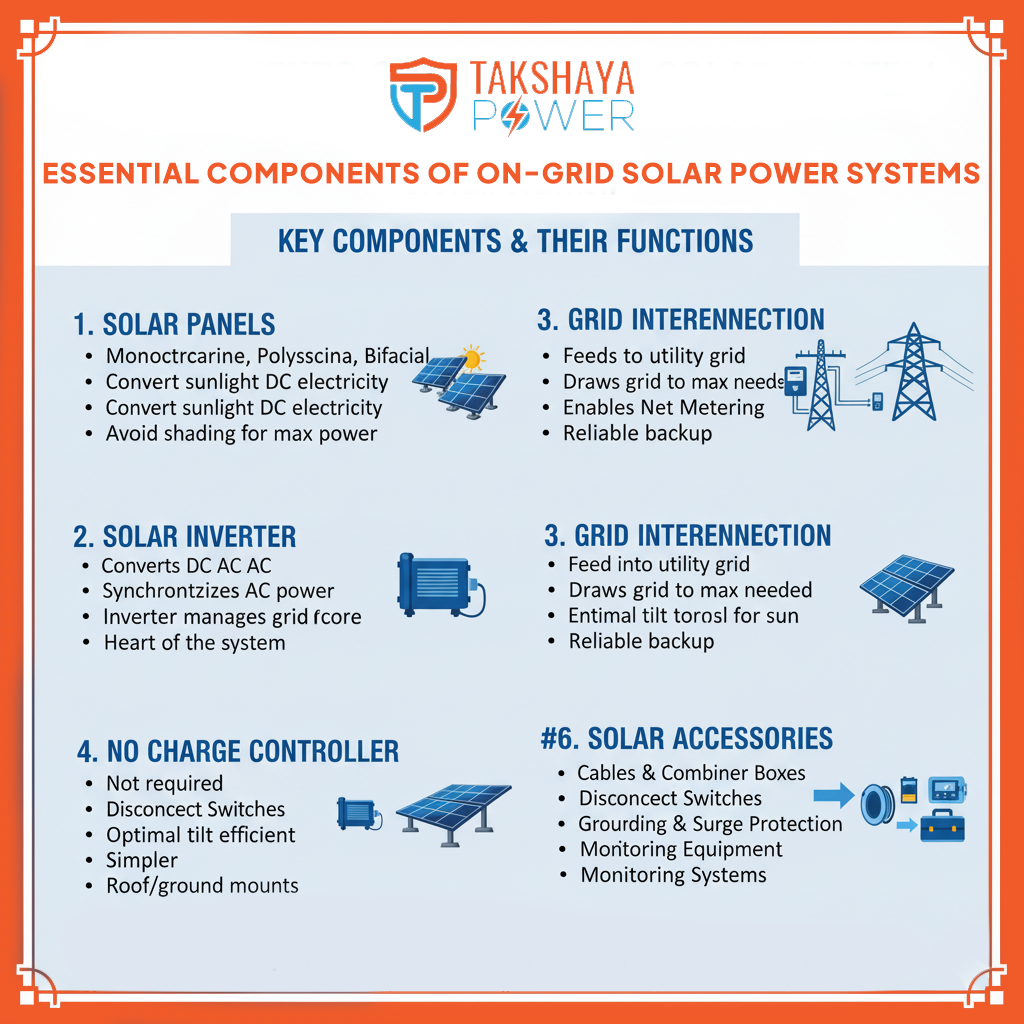
Solar panels, composed of photovoltaic (PV) cells, are responsible for capturing sunlight and converting it into Direct Current (DC) electricity. Panels vary in type:
Monocrystalline: Made from a single silicon crystal, generally offering higher efficiency.
Polycrystalline (Multicrystalline): Constructed from multiple silicon crystals, often a more cost-effective option.
Bifacial: Designed to capture sunlight on both their front and rear surfaces, maximizing energy capture.
Proper installation is crucial for on-grid systems; panels should be strategically positioned to avoid shading and ensure optimal tilt and orientation, guaranteeing maximum sunlight absorption and energy production for both home use and grid export.
The solar inverter is a critical component, often referred to as the “heart” of an on-grid solar system. Its primary role is to efficiently convert the DC power produced by the solar panels into Alternating Current (AC) electricity. This AC power is then suitable for direct consumption by household appliances and for seamless export to the public utility grid. On-grid inverters also manage synchronization with the grid’s frequency and voltage, ensuring stable and safe operation.
For on-grid solar systems, direct interconnection with the public utility grid replaces the need for primary battery storage. This setup allows for:
Immediate Consumption: Electricity generated by panels powers the home directly.
Net Metering: Any excess power produced is automatically fed back into the utility grid, often earning the homeowner credits or reducing their overall electricity bill.
Reliable Backup: When solar production is insufficient (e.g., at night or on heavily overcast days), the home seamlessly draws electricity from the grid, ensuring an uninterrupted power supply without the added cost and maintenance of batteries.
In an on-grid solar system, a dedicated charge controller, which is essential for battery management in off-grid systems, is generally not required. The solar inverter directly handles the power from the panels, converting it and managing its flow to either the home’s loads or the utility grid.
Essential for system setup, robust mounting structures securely hold the solar panels in place on rooftops or ground arrays. These structures must be installed at an optimal tilt angle and orientation, ensuring the panels receive maximum sunlight exposure throughout the day. This precise positioning is vital for maximizing electricity generation, which directly translates to greater energy savings and potential grid credits.
Beyond the primary components, several essential accessories ensure the safety, efficiency, and compliance of an on-grid solar system. These include:
DC cables and DC combiner box: For securely transmitting and consolidating DC power from panel strings to the inverter, including overcurrent protection.
AC cables and AC combiner box: For safely carrying AC power from the inverter to the main electrical panel and the utility grid.
MC4 connectors: Industry-standard connectors ensuring secure, weatherproof DC connections between panels and wiring.
Earthing strips and conduit trays: Fundamental for electrical safety, providing proper grounding for the system and protecting wiring.
Lightning arrester: A vital safety device installed to protect the solar system and property from damage caused by lightning strikes.
Net Meter: A specialized bi-directional meter installed by the utility company to accurately measure both electricity consumed from the grid and excess electricity fed back into it.
Off-grid solar systems are an excellent choice for illuminating homes in Indian rural areas plagued by absent or inconsistent grid power. They provide a reliable, clean energy source that powers residences without environmental pollution. Despite a higher upfront cost compared to on-grid solar systems in India, the investment in an off-grid solution is justified by the critical need for power independence. These systems are also increasingly valuable for powering industrial operations.

