
Corporate office:- 320, Ahimamau Arjunganj , Lucknow Uttar Pradesh - 226002.
Branch Office :- Shanti Nagar Colony , Near Padmawati Mahila Degree College Chitaipur BLW , Varanasi - 221106.
An off-grid, or standalone, solar system converts sunlight into electricity using photovoltaic (PV) cells, similar to grid-connected systems. The key distinction is its complete independence from the utility grid. Instead of feeding excess power back to the grid, off-grid systems rely on batteries to store the electricity generated during daylight hours for later use.
Cost and Maintenance Considerations in India:
Generally, the initial investment for an off-grid solar system in India is higher compared to an on-grid setup. This is primarily due to the inclusion of batteries, which are a significant component. Furthermore, off-grid systems typically incur greater maintenance costs and effort, as batteries have a finite lifespan and require periodic replacement to ensure continuous system operation.
To provide a general cost estimate, here are approximate market prices for off-grid solar systems in India:
3 kW Off-Grid Solar System
5 kW Off-Grid Solar System
Please Note: These figures are standard market estimates and do not represent pricing from TAKSHAYA POWER PRIVATE LIMITED, as our primary focus is not on off-grid solar installations.
Is Off-Grid Solar Right for You?
Before investing, it’s crucial for Indian homeowners to weigh the benefits and drawbacks of off-grid solar, especially considering the government subsidies available for on-grid rooftop solar installations. This guide aims to help you understand the workings, pricing, and suitability of off-grid solar for your specific needs.
An off-grid solar system functions as a completely independent electrical power source, intentionally disconnected from the public utility grid. Its core purpose is to generate its own power and store it efficiently in batteries, ensuring a continuous and reliable electricity supply, even in the absence of external infrastructure.
Beyond the major components, a range of essential solar accessories ensures the safe, efficient, and reliable operation of the entire off-grid system. These include:
Cabling (DC and AC): Specifically rated and sized cables to minimize energy loss and ensure safe transmission of electricity throughout the system.
Combiner Boxes: Used to aggregate wiring from multiple solar panel strings and often house overcurrent protection (fuses or circuit breakers) for each string.
Disconnect Switches: Critical safety devices that allow for manual isolation of different parts of the system for maintenance, troubleshooting, or emergencies.
Grounding Equipment: Essential for electrical safety, protecting against electrical faults and lightning strikes.
Surge Protectors: Devices that protect sensitive electronic equipment from voltage spikes caused by lightning or other electrical disturbances.
Monitoring Systems: Increasingly common, these allow users to track system performance, battery state of charge, energy production, and consumption in real-time, often via mobile apps or web portals.
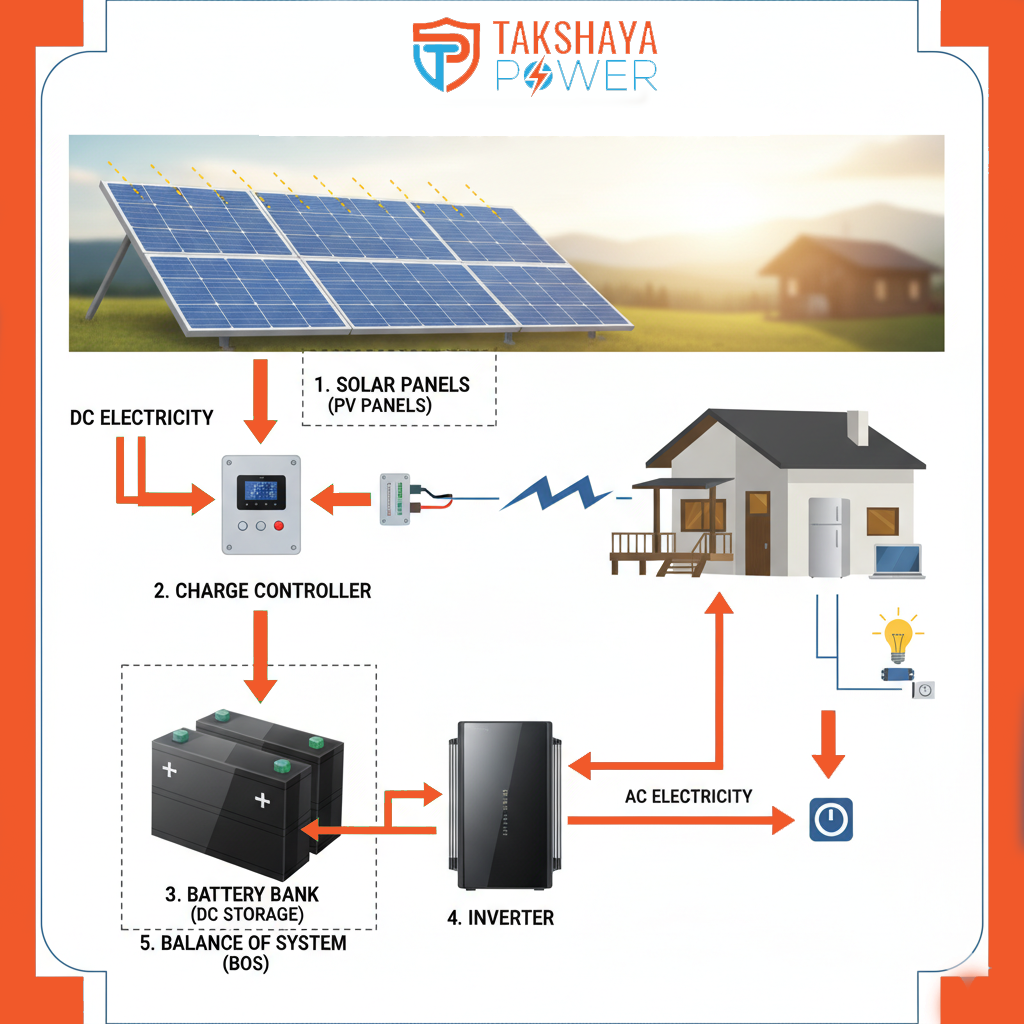
While on-grid rooftop solar systems are typically sufficient, more affordable, and easier to maintain for the majority of Indian homes, there are specific scenarios where an off-grid solar system is essential.
Consider an off-grid solution if:
Your location is remote and lacks a public utility grid connection.
Your region suffers from extensive power cuts, making the existing grid unreliable.
Conversely, for locations with a robust and stable grid connection, an on-grid solar system provides unparalleled benefits.
Now, let’s break down the entire off-grid solar system component by component so you can understand the role of each individual component in electricity generation.
#1. Solar panels
Solar panels are made up of solar cells.
Off-grid solar panels trap sunlight and convert it into DC electricity. The one thing that should be taken care of at the time of installation is that shadows should not cloud the panels.
#2. Solar inverter
The power from solar panels is in the form of direct current. Home appliances run on AC power. This is where the solar inverter comes into the picture. It converts DC power into AC power. An off-grid solar inverter, just like an on-grid inverter, is the heart of the solar system.
#3. Batteries
Off-grid solar functions on batteries.
#4. Charge controller
The charge controller in an off-grid solar system controls the charge.
#5. Mounting structures
You have the panels and the inverter, but the system cannot be set up without proper mounting structures. The mounting structures should be at a proper tilt angle (near perpendicular to the sun for as long as possible) so that they receive maximum sunlight.
#6. Solar accessories
You know the major components of an off-grid solar system, but there are other accessories without which the system will not be safe. Here are the accessories we’re talking about:
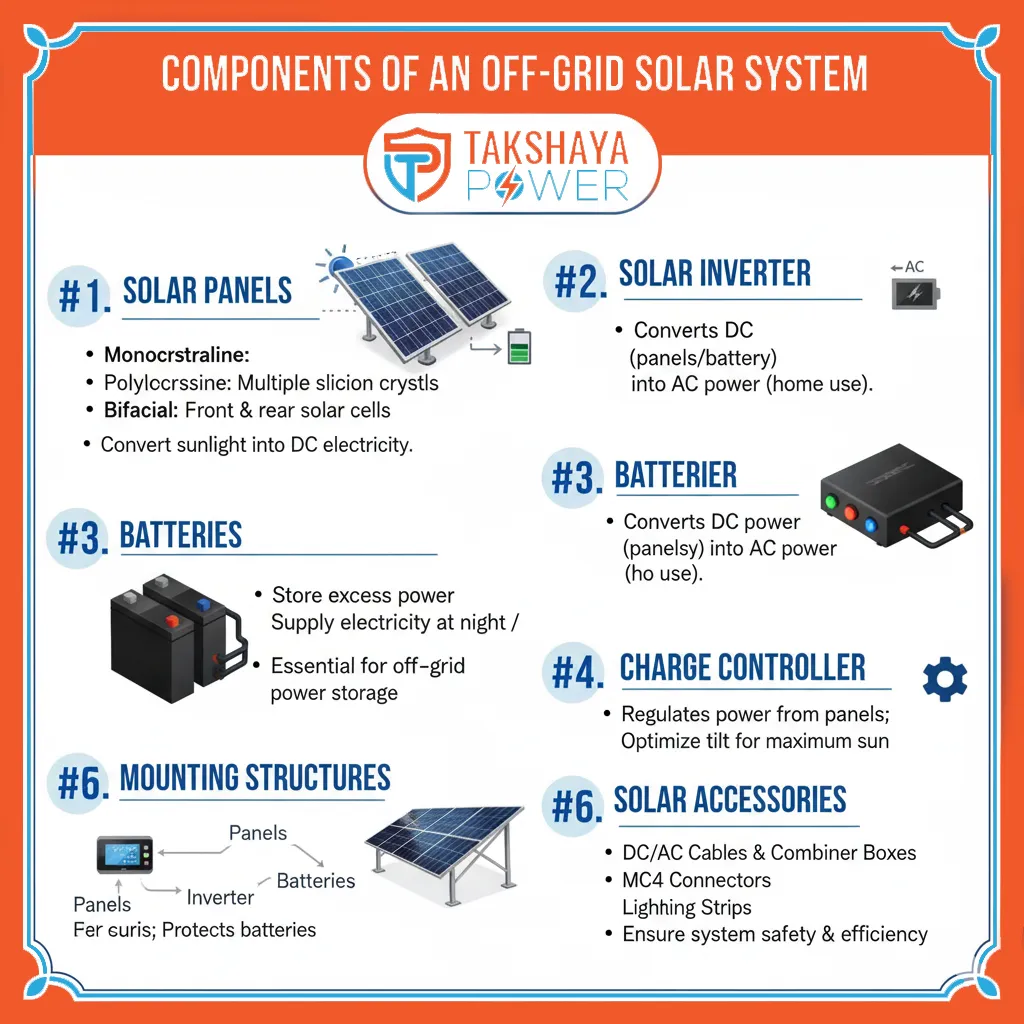
Solar panels, composed of photovoltaic (PV) cells, are responsible for capturing sunlight and converting it into Direct Current (DC) electricity. Panels vary in type:
Monocrystalline: Made from a single silicon crystal.
Polycrystalline (Multicrystalline): Constructed from multiple silicon crystals.
Bifacial: Designed to capture sunlight on both their front and rear surfaces.
Proper installation is crucial; panels should be positioned to avoid shading, ensuring maximum sunlight absorption.
The solar inverter is a critical component, often referred to as the “heart” of the solar system. Since solar panels produce DC power and most household appliances operate on Alternating Current (AC), the inverter’s role is to efficiently convert the DC electricity into usable AC power.
Batteries are fundamental to off-grid solar functionality, providing essential energy storage. During periods of sunlight, excess electricity generated by the panels charges the batteries after meeting immediate household demands. This stored power then ensures a continuous electricity supply, particularly for nighttime use or during cloudy conditions.
The charge controller manages the flow of electricity within the off-grid system. It regulates the power from the solar panels, directing it to either the inverter to supply immediate loads or to the batteries for storage. This protection prevents overcharging and optimizes battery health.
Essential for system setup, mounting structures securely hold the solar panels in place. They must be installed at an optimal tilt angle, ideally near-perpendicular to the sun’s path for extended periods, to maximize solar energy capture.
Beyond the primary components, several essential accessories ensure the safety and efficient operation of the off-grid system. These include:
DC cables and DC combiner box
AC cables and AC combiner box
MC4 connectors
Earthing strips and conduit trays
Lightning arrester
Off-grid solar systems are an excellent choice for illuminating homes in Indian rural areas plagued by absent or inconsistent grid power. They provide a reliable, clean energy source that powers residences without environmental pollution. Despite a higher upfront cost compared to on-grid solar systems in India, the investment in an off-grid solution is justified by the critical need for power independence. These systems are also increasingly valuable for powering industrial operations.

